
Not all wilderness is scenic. In this essay, we walk through the everyday wilderness—kitchens, commutes, parenting, finances, and time scarcity—where pressure trains our defaults and the inner life shows itself. We close with a simple practice: noticing the first 30 seconds under stress and returning to base camp before habit energy takes over.
Read to the end for the weekly practice.
Not everyone can step onto a trail.
Not everyone has the time, the money, the health, or the season of life to disappear into the mountains for three days. Some people are in a wilderness they can’t leave because it lives right where they live.
And that’s the point I don’t want you to miss:
The wilderness that forms you most may not be the dramatic wilderness.
It may be the ordinary one.
The everyday wilderness is not scenic. It doesn’t come with granite peaks or a summit photo. Most days it comes with two jobs, a schedule that’s too tight, a child who is melting down, a parent who needs help, a commute you didn’t want, a meeting that starts too early, a body that feels heavy, and a mind that won’t stop rehearsing everything that could go wrong and everything that already has.
This wilderness doesn’t announce itself. It doesn’t have to because we are constantly on the trail. And because it’s constant, it shapes us quietly – through repetition.
Ordinary pressure is often the most formative
In the high wilderness, pressure is obvious: cold, altitude, fatigue, weather. You can name it. You can plan for it. You can tell stories about it.
In the everyday wilderness, pressure is quieter—and that’s why it can be more formative.
It shows up as:
- time scarcity
- constant interruption
- noise
- decision fatigue
- financial stress
- chronic uncertainty
- small conflicts that never resolve
- responsibilities that don’t stop
And because it’s “normal,” we stop noticing what it’s doing to us.
The danger isn’t that we face ordinary pressure.
The danger is that ordinary pressure trains us into a default.
Where the default shows up fastest
If you want to know what governs the inner life, don’t wait for a major crisis. Watch what happens in the small moments.
Watch your first reaction when:
- you’re late, or when someone else is late and it inconveniences you
- a co-worker rolls his eyes at a comment you make
- your 4-year-old takes forever with shoes on and you’re running late
- the school calls again – while you’re at work
- your dog suddenly explodes into barking at the door
- the electricity bill is higher than expected
- your boss doesn’t notice the extra work
- your spouse corrects you in front of your friends
That’s where the wilderness shows itself.
Not in what you believe about yourself, but in what you do before you have time to edit.
That’s why I call it wilderness. It reveals what governs us.
Tone shows up fast.
Impatience shows up fast.
Withdrawal shows up fast.
Control shows up fast.
Sarcasm shows up fast.
People-pleasing shows up fast.
The need to be right shows up fast.
And because these moments are small, we excuse them.
“It’s been a long day.”
“I’m just tired.”
“That’s just how I am.”
“They always do this!”
Repeated small moments harden into habit energy – responses that become automatic. Over time these habit energies solidify into internal systems. They become a way of living.
And then one day we realize we’ve become someone we didn’t intend to become.
Hard miles are honest teachers
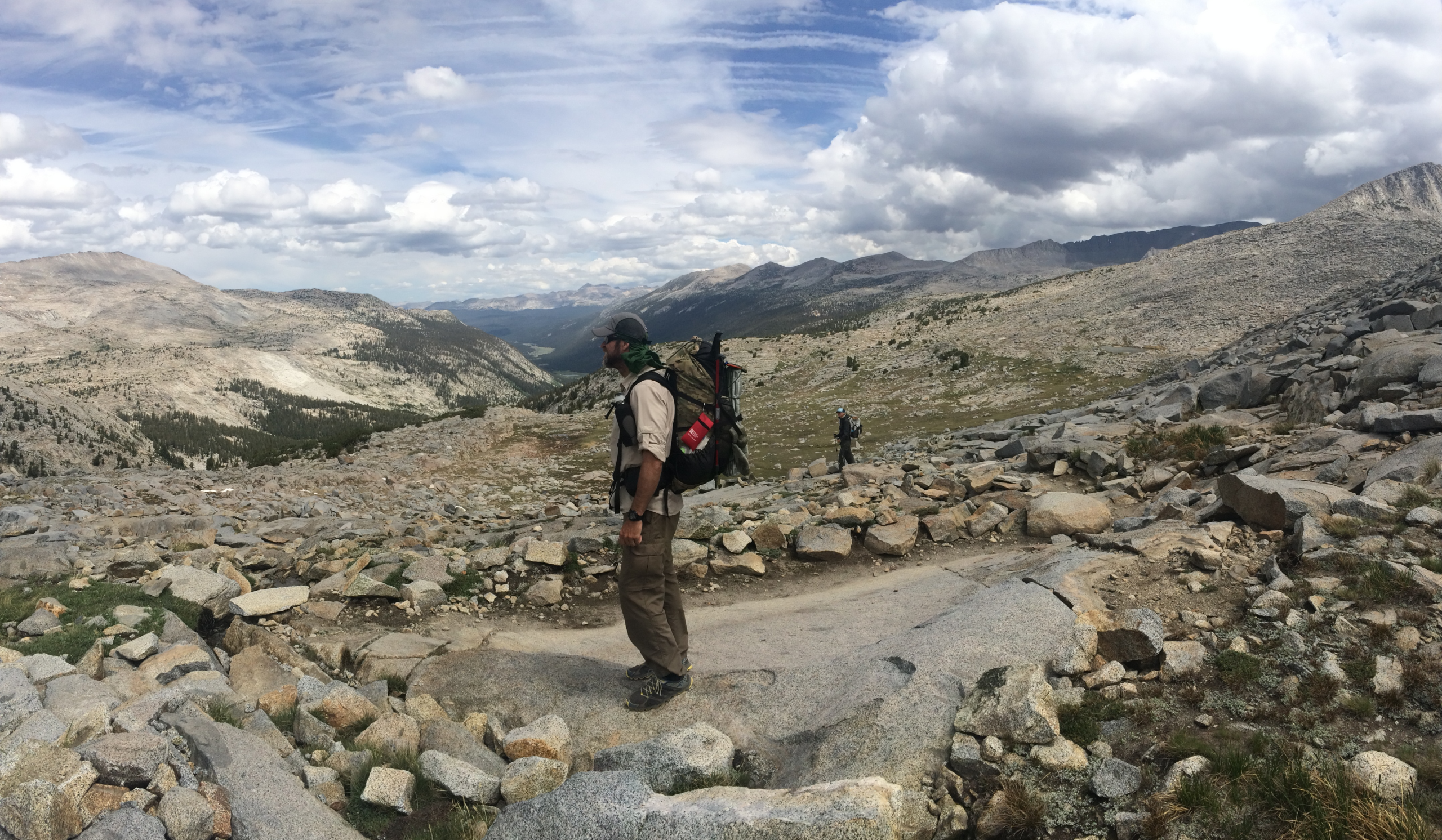
Some trek miles are objectively harder than others. On the John Muir Trail, the switchbacks leading up to Donohue pass don’t look too difficult, but they were an endurance test! At one point we reached a saddle where a group of people were having a lunch break. I felt such relief until I looked beyond and realized that Donohue Pass was the next one and much higher! These are the grinding miles that test our stamina and resolve.
While working on my Master’s degree at the University of Utah, I was also a special education teacher of junior high school students with severe behavior and emotional disorders, was a scout leader at our church – and a husband and father. Those were hard miles – for me and my wife!
A new baby. An exploring toddler. A developing teenager. Aging parents. Financial strain. Health issues accompanied by chronic pain. A job that asks more than it gives back. A marriage under pressure. A year where you can’t catch your breath.
Hard miles are not proof that you’re failing. They are often just part of the trek of life.
But hard miles leading to a summit or pass are honest. They don’t care about your image. They’re deaf to complaints – even those laced with curse words. They reveal what you’re carrying.
That doesn’t mean you should shame yourself for what shows up.
It means you should learn from it.
Wilderness — especially everyday wilderness — is a teacher, if we pay attention.
Companion guide: Thich Nhat Hanh and the return to the present
One reason I keep Thich Nhat Hanh close to me as a guide is because he brings the work down to ground level.
Not grand ideas. Not dramatic transformation.
Just the breath.
The present step.
The present moment.
His wisdom is simple enough to practice in a kitchen. In a hallway. In a car. In the first thirty seconds of a hard moment—before habit energy takes over.
And that’s where real change begins: not with a new personality, but with a small return to presence.
You come back to the body.
You come back to breath.
You come back to what is real right now.
You stop fueling the inner storm.
You return to your inner space – your base camp.
This is not escape. It’s the beginning of freedom.
If you only remember one thing from this post: notice the first 30 seconds
Internal Practice — The First 30 Seconds
Most people don’t lose their integrity in one dramatic collapse. They lose it in a thousand small reactions that go unexamined.
This week, we’re going to practice one thing:
Notice the first 30 seconds.
Step 1: Choose one everyday trigger
Pick one moment that reliably activates you:
- being late
- kids arguing
- a rude text or email
- a partner’s tone
- traffic
- money stress
- being interrupted
- feeling ignored
Step 2: When it happens, don’t fix it—notice it
For the first 30 seconds, your job is not to solve the situation.
Your job is to observe what rises in you.
Ask:
- What do I feel in my body? (tight chest, clenched jaw, heat, restlessness)
- What is the first story my mind tells?
- What do I immediately want to do? (control, withdraw, attack, explain, defend)
This is internal wilderness mapping.
Step 3: Return to breath—three times
Take three slow breaths.
You don’t need a perfect meditation. Just a return.
In-breath: I’m here.
Out-breath: I can choose.
Step 4: Choose one small “better” response
Not heroic. Not perfect. Just better. A choice you can fully own:
- soften your tone
- ask one honest question
- delay your reply
- name what you’re feeling without blaming
- step away for sixty seconds
- tell the truth simply
- stop performing and be present
Step 5: Learn something for the next trek
Later—when it’s calm—write one sentence:
“In the first 30 seconds, my default is… and next time I want to…”
That sentence becomes a trail marker.
Because the everyday wilderness is shaping you—whether you notice it or not.
And if you can learn something from it, you don’t have to waste the hard miles.
Learn something for the next trek.
In the next post, we’ll explore The Wilderness We Choose—the paths we walk into knowingly or unknowingly, how habit energy carries us, and how returning to base camp helps us reorient before we drift too far.
Thanks for reading Greybeard Philosophy. If this essay helped you, stay with the practice—small and faithful is enough.
If it is helpful to you, please share with someone you care about.
Until next time: by kind to yourself and learn something for the next trek.