
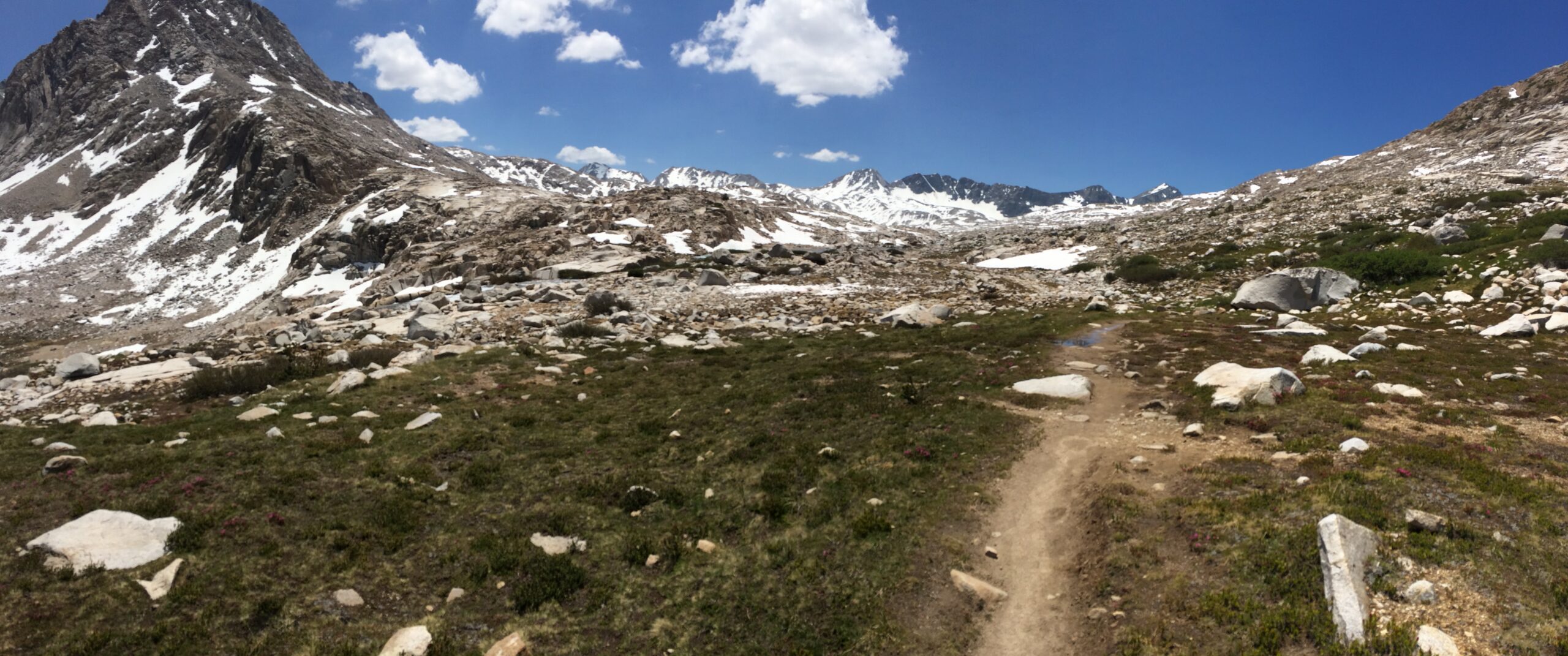
Tag line: The repeated choices of an unexamined life carve paths—habit energy strengthens and carries us into unintended wildernesses.
Read to the end for the weekly practice.
Not all wilderness rolls in like a weather front.
Most wildernesses have trailheads. The trek begins with a choice—sometimes a bold choice to summit a mountain or to trek more than four months and 2,653 miles from Mexico to Canada on the Pacific Crest Trail. These chosen treks often simmer for months or years inside a person’s heart and soul, building the momentum needed to plan, prepare, practice, and finally set out.
These chosen treks are often accompanied by significant challenges—swarms of mosquitoes, thunder storms, hiker hunger, weight loss, plantar fasciitis, physical and mental fatigue. From firsthand experience, I can tell you they are also filled with beauty. There is something powerful in knowing the only way to experience that depth of beauty is to walk the path. And because these wilderness treks are consciously chosen, we name the pain and drive on to the summit or to the terminus.
Some of life’s greater wilderness treks also have trailheads. These life treks begin with a choice—sometimes a bold choice to earn a college degree, to start a business, to start a family, to enter politics, to buy a home, to overcome an addiction, to end an abusive relationship. These chosen life treks often simmer for years inside the heart and soul, building the momentum and courage to plan, prepare, practice, and finally set out.
These treks are often accompanied by seemingly insurmountable challenges. And I can attest: these life treks are also filled with beauty. Again, there is something powerful in knowing the only way to experience this depth of beauty is to walk the path—to a family, to a degree, to a business, to sobriety, to a healthy relationship.
But other wilderness treks are not consciously chosen—and yet they are still chosen.
There is a trailhead, but it is either unseen or ignored. There are guides and maps, but they are either unknown or dismissed. There is a compass and a north star, but the compass is abandoned and the stars go unnoticed.
The hiker walks the unexamined trail through unmarked and unmanaged country—sometimes in circles—coming back around to where they began, only faintly recognizing they’ve been here before. This time, they resolve to stay on managed paths… consult guides and maps… use their compass. And again they make the same circular trek—bushwhacking through unmanaged terrain, making and breaking the same commitments—until they’ve worn their own path and conclude they are simply a victim of an unchanging and unfriendly wilderness.
I’ve seen this circular trek in organizations, and I’ve lived it myself.
For a few years as an executive leader, I lived inside a loop that felt responsible, even noble. Every week began with good intentions—priorities, goals, the “big rocks.” But by Tuesday, the day had shifted. A teacher conflict. A staffing gap. A parent phone call that couldn’t wait. A student crisis. A facilities issue. A district deadline. A budget concern. And because I cared—and because the work mattered—I kept stepping off the trail to handle the immediate problem.
By Friday afternoon, I would sit in my office staring at a list that had only grown. The important work—coaching leaders, strengthening instruction, building culture, thinking long-term—had been pushed aside again. I’d promise myself, Next week will be different. Then Monday would arrive and I’d do it again.
It wasn’t that I lacked discipline. It was that I was bushwhacking through other people’s emergencies without noticing I’d created a path of my own: a pattern where urgency ruled, boundaries dissolved, and my inner life stayed on the run. The loop became familiar. I could navigate it in the dark. And that’s how you know you’re in a circular trek: you recognize the terrain, you’re exhausted, and yet you keep ending up in the same place.
That’s the wilderness we choose—not by one dramatic decision, but by a thousand small concessions to urgency. After a while, you stop asking, Where am I actually going? You just keep moving.
These are the wildernesses we choose—knowingly or unknowingly.
The wilderness we choose knowingly
Some paths are obvious.
We know where they lead, even if we don’t want to admit it.
We choose them anyway:
- the habit we keep feeding
- the compromise we keep excusing
- the anger we keep rehearsing
- the relationship we keep misusing
- the lie we keep “justifying”
- the appetites we refuse to govern
This kind of wilderness isn’t mysterious. It’s familiar. We step into it with eyes open—and sometimes we even call it freedom. “You do you.” Moral relativism. “It’s my life.”
But it’s not freedom. It’s walking an unmanaged path—with permission.
The wilderness we choose unknowingly
The more common wilderness is quieter. It doesn’t begin with rebellion. It begins with the unexamined life. It begins with:
- postponing the hard conversation
- avoiding the honest look inward
- numbing with noise or addiction
- living on reaction
- treating your inner life like an afterthought
Then the choices repeat. And repeated choices generate habit energy—the momentum that carries you forward even when you aren’t consciously choosing anymore. At that point, people start saying things like:
“I don’t know how I got here.”
“This isn’t who I want to be.”
“Why do I keep doing this?”
“I can’t seem to change.”
Often the answer is simple and sobering:
You did choose.
Just not all at once.
And not always knowingly.
Habit energy carried you—step by step—into a wilderness you now experience as a place you can’t find your way out of.
Internal systems can keep us in wilderness
This is where the examined life becomes urgent. Because by the time we realize we’re in the wilderness, we’re often not dealing with one bad decision. We’re dealing with an internal system—a set of defaults that run without permission:
- tone that hardens before you notice
- facial expression that reveals irritation
- withdrawal that feels safer than truth
- control that masquerades as responsibility
- people-pleasing to avoid conflict
- avoidance that becomes “being busy”
These are not just behaviors. They are signs of governance—signals that something in the inner life is running the show. When that happens, trying harder usually doesn’t work. You don’t “push through” a wilderness you created through repetition.
You reorient. You return to Base Camp.
For me, base camp has often been as simple as a driveway. Leading a charter school is both rewarding and stressful. For years I often arrived before sunrise and left well after sundown. Many nights I left my office only after a phone call meant to calm an upset parent—one more attempt to steady the waters before I went home.
Early in my career, one of my mentors gave me simple counsel: when I pull into the driveway at night, I’m not to walk straight into the house still carrying the school. He told me to stay in my truck for a minute and shift back to being a husband and father.
That was my nightly return to base camp.
Some nights my sweet wife would text, When are you coming in? And I’d realize I was still sitting there—mind racing, jaw tight, already planning tomorrow’s problems. Most nights it took only a few minutes: a breath, a slowing down, a reorientation to what mattered most—my relationship with my wife and children. Then I’d open the door and step inside with a different spirit. It wasn’t dramatic. But it was a practice. And it saved me from carrying one wilderness straight into another.
Companion Guide: Marcus Aurelius and the inner retreat
We often assume we need an external retreat to regain clarity—mountains, seashores, cabins, silence. Marcus Aurelius understood that impulse, and he challenged it.
He wrote that people “seek retreats for themselves” in houses in the country, by the sea, and in the mountains. But he called that “a mark of the common sort of man,” because a truer retreat is available at any moment: to retire into yourself.
Then he names what that inner retreat actually offers:
“For nowhere with more quiet or more freedom from trouble does a man retire than into his own soul.”
That is Base Camp language.
And Marcus doesn’t leave it as an inspiring idea. He turns it into a discipline:
“Constantly then grant yourself this retreat and refreshment; let your principles be brief and fundamental…”
Why brief and fundamental? Because when pressure narrows options, you don’t have time for a dissertation inside your head. You need a small set of true north principles you can call to mind quickly—principles that, as Marcus says, are “sufficient to cleanse the soul completely.” This is the examined life in its simplest form: return inward, reorient to true north, and choose again.
Marcus presses the point even further:
“Perceive at last that you have within you something better and more divine than the things which cause the various effects and, as it were, pull you around by strings (habit energy!). What is there now in your mind? Is it fear, or suspicion, or desire, or anything of the kind?”
Base Camp is the inner retreat—quiet and freedom from trouble—where brief and fundamental principles restore the soul and make choice possible.
Examine the wilderness to reorient the map
When you realize you’re in a wilderness your habit energy helped create, the temptation is shame.
But shame rarely leads to clarity. It leads to hiding.
The better move is honest examination:
- What choices have I been repeating?
- What has that repetition trained in me?
- What is my default under pressure?
- What principle have I been violating—quietly, consistently?
- What guide or map have I stopped consulting?
And here is the practical truth for me: when I fail—or get too busy—to consult my map, the week becomes frantic. I’m pulled by other people’s issues and emergencies. I’m reactive instead of principled. It becomes much harder to remain centered on what matters most, because I’m no longer choosing the trail—I’m just responding to the terrain.
As Stephen Covey said, I’m “caught in the thick of thin things.”
But even without Covey, I know exactly what it feels like: I stop navigating by true north, and I start navigating by urgency. That’s when habit energy takes over—and that’s how a week becomes a wilderness I didn’t intend to enter.
This is how you orient the map. Not by pretending you’re not lost.
Not by blaming the guides, the maps, the compass, the terrain, or the weather.
But by telling the truth, returning to Base Camp, and choosing again.
Because the wilderness you choose is not meant to become your permanent address. It’s meant to become your teacher. And if you learn something here, you don’t have to waste the miles.
Internal Practice — The Weekly Base Camp Retreat (30 minutes)
Step 0 — Enter Base Camp (Stop, Calm, Rest, Heal)
(5 minutes before you begin the retreat)
Before you examine the week, enter base camp. Not as an idea—but as a practice.
The first work is to stop the forward momentum of habit energy. If you don’t stop it, you’ll bring the wilderness into the retreat and call it reflection—when it’s really just rehearsing.
1) Stop (30 seconds)
Sit down. Put the phone out of reach, out of sight.
Place both feet on the ground.
Say quietly: “I have arrived.”
This is Thich Nhat Hanh’s first invitation: stop running. Come home.
2) Calm the mind (2 minutes — Shamatha)
Bring attention to the breath at the nostrils or the rise and fall of the belly.
Don’t force a special state. Just stay near the breath.
Count ten breaths—softly in your mind:
- inhale (1), exhale (1)
- inhale (2), exhale (2)
…until ten.
If you lose count, begin again at one. That’s not failure—that’s training.
3) Rest (1 minute)
Now release the counting and let the breath be natural.
Let the mind settle like silt in a jar of water.
If thoughts come, don’t wrestle them. Notice them, and return to breath.
Say quietly on an out-breath: “Release.”
4) Heal (1 minute)
Place a hand on your chest or over your belly—where you feel stress most.
Offer yourself one honest sentence:
- “This has been a hard week.”
- “I am tired.”
- “I am here now.”
Then one gentle commitment:
- “For the next 30 minutes, I will not rush.”
- “For the next 30 minutes, I will tell the truth.”
- “For the next 30 minutes, I will return to base camp.”
5) Open the retreat (10 seconds)
Write one line at the top of the page:
“I return to base camp to stop habit energy, calm the mind, rest, and heal.”
Then begin Step 1.
1) Wilderness Review (8 minutes)
Wilderness without: what happened around you
Wilderness within: what it revealed within you
A. Wilderness without (3 min)
Write:
- “The hard miles this week were…”
- “The pressure points were…”
B. Wilderness within (5 min)
Answer quickly (no essays):
- Under pressure, my default showed up as… (tone, impatience, withdrawal, control, avoidance, people-pleasing, performance)
- What I did well—steady and clean—was…
- Where I drifted was…
- What I tolerated that trained me the wrong way was…
Circle one recurring pattern. That’s your trail report.
2) Consult Your Map (8 minutes)
Write at the top of a page:
“My map right now…”
Then answer:
- Do I know where I’m trying to go?
Write one sentence:
“The direction I want my life to move is…” - What direction did my habit energy pull me this week?
Write one sentence:
“My habit energy pulled me toward…”
(reactivity, numbing, control, resentment, avoidance, distraction, courage, truth—name it) - Is my map aligned with true north principles?
List 2–3 true north principles you want to be governed by:- “Tell the truth.”
- “Be steady.”
- “Do not trade integrity for relief.”
- “Choose patience.”
- “Return to the present moment.”
Then ask:
“Where did I live aligned with these?”
“Where did I violate them—quietly, repeatedly?”
This is the examined life: not self-condemnation—reorientation.
3) Stewardship Check (6 minutes)
Choose three stewardships to review (pick what fits your life):
- Body / health
- Relationships (marriage, parenting, friendships)
- Work / craft
- Attention (inputs, screens, pace)
- Money / resources
- Home / land (house, garden, animals)
- Inner life (silence, prayer, reading, reflection)
For each stewardship, write three short lines:
- Tended: “This week I cared for this by…”
- Neglected: “I drifted here by…”
- Repair: “One small repair next week is…”
Keep it small and doable. Base camp work is faithful work.
4) Consult a Guide (4 minutes)
Read one short passage (a paragraph or a page) from a guide.
Write:
- “The line that stayed with me is…”
- “The correction it offers me is…”
- “The practice it calls for next week is…”
5) Recommit (2 minutes)
Choose one brief and fundamental principle for the coming week.
Write:
- My principle: “__________.”
- When pressure narrows options, I will: “__________.”
(pause, breathe, delay response, soften tone, tell the truth plainly, step away for 60 seconds, ask one honest question)
Close with a single trail marker sentence:
“Next week, I will return to base camp when…”
(and name your most common trigger)
Close (30 seconds)
Write one final line:
“Learn something for the next trek: __________.”
That sentence becomes your compass note for the week ahead.
This is why the weekly retreat matters: it breaks the loop before habit energy carries you another mile in the wrong direction. But even the most examined life cannot prevent every wilderness—some find us without consent.
In the next post, we’ll shift to a different kind of wilderness—the wilderness that finds us without our consent. When suffering narrows options from the outside, what remains of freedom? Viktor Frankl will be our guide there.
Thanks for reading Greybeard Philosophy. If this essay helped you, stay with the practice—small and faithful is enough.
If it is helpful to you, please share with someone you care about.
Until next time: by kind to yourself and learn something for the next trek.