
Part 1: The validation treadmill asks, “Who saw me?”
Tagline: A clean deed can be shared, but it must be able to survive invisibility.
The trail doesn’t validate your parking or your ego. It asks only what you are carrying.
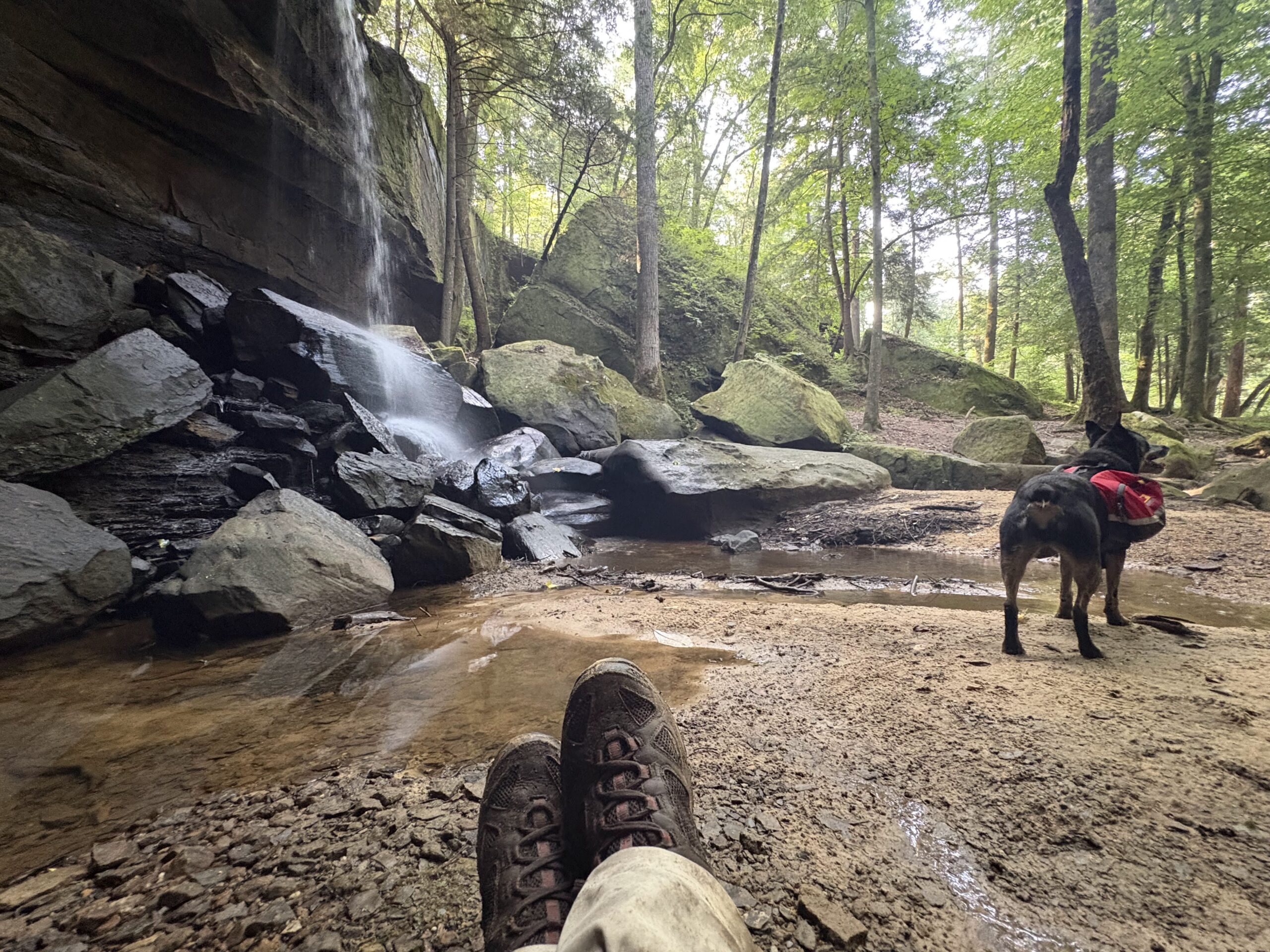
I wrote that before leaving for the Alabama Sipsey Wilderness, not fully understanding how quickly the trail would test it. I had planned a three-day, thirty-mile trek through the Big Sipsey Loop with Carleigh, my faithful dog and trail companion. I hadn’t been out for many months—perhaps years in any serious backpacking sense—and I knew the trip would test more than legs. It would test motive.
Before I even left home, I could feel the old machinery starting up inside me. Instead of simply loading the pack and leaving, I busied myself with unnecessary tasks. I even found myself preparing sweet potato slips in water for planting when I returned, as though the garden suddenly required attention right then. But beneath the activity was something else.
Nervousness.
Not just nervousness about heat, humidity, distance, water, terrain, or weather. Something more interior. A quiet dread that the trail might find me out.
What if I was not as seasoned as I had portrayed myself to others?
What if the image of backpacker, veteran, outdoorsman, and disciplined old trail man was stronger than the current reality?
What if I could no longer do what I thought I could do?
What if I was exposed as a backpacking fraud?
That is how the Validation Treadmill works. It doesn’t always begin with applause. Sometimes it begins with the fear of losing applause.
As I prepared to leave, I thought of people my age traveling comfortably in RVs, moving through the country with air conditioning, soft beds, refrigeration, and easy stopping points. And there I was, loading a pack, taking Carleigh, and driving toward a wilderness where I knew I would suffer.
Why? That was the question I could not avoid.
Was I going because I loved the wilderness?
Was I going because solitude, trail, dog, creek, and silence still call to something true in me?
Was I going because I needed the pressure of the trail to reveal what office life had hidden?
Or was I trying to prove something?
To myself?
To my wife? To my grown children and especially my son Danny? To my imagined readers?
To some invisible audience still seated in the theater of my mind?
If the only “why” behind the hike was the witness of having done it, then the trek would become miserable even before I stepped onto the trail.
That was the first lesson.
The Validation Treadmill isn’t merely the hunger to be praised after the deed. It is the corruption of motive before the deed is even done.
Epictetus understood this with severe clarity.
He chided those who spoke, read, served, and disputed not for the sake of truth or usefulness, but for the admiration that might follow. His question cuts through pretense:
Would you be useful, or be praised?
That question belongs at the trailhead.
Would you walk the loop, or be known as the man who walked the loop?
Would you write the lesson, or be admired for having written it?
Would you do the deed, or use the deed to feed the old hunger?
Would you serve, or be seen serving?
Would you endure, or be applauded for endurance?
This is where motive becomes a Base Camp issue.
Base Camp is the self—the inner place where attention, desire, judgment, conscience, and will are formed. If Base Camp is cluttered with the need to be admired, even good deeds begin to rot from within. The outward act may still look noble. A person may still hike, teach, lead, give, serve, write, preach, or sacrifice. But if praise is the hidden wage being sought, then the deed has already begun to sour.
Jesus of Nazareth warned of this same danger in the Sermon on the Mount.
He spoke of those who gave alms “to be seen” by others.
Take heed that ye do not your alms before men, to be seen of them: … when thou doest thine alms, do not sound a trumpet before thee, as the hypocrites do that they may have glory of men. Verily I say unto you, They have their reward. Matthew 6:1-2
The deed of alms giving was outwardly generous, but the motive had become theater. The point was not that generosity is wrong or that all public good must be hidden. The warning was sharper: if praise is the reward you seek, praise is the reward you receive.
The transaction is complete. The deed has been spent. That is the danger of doing good work for the wrong witness.
Before stepping onto the Sipsey trail, I entered Base Camp the best I could. I paused at the threshold, tried to quiet the old executive habit energy, and reminded myself:
I have arrived at the trailhead.
I don’t need this hike to prove anything.
Then I breathed:
Breathing in I am calm, breathing out I am restful.
Breathing in I am calm, breathing out I am restful.
Breathing in I am calm, breathing out I am restful.
Breathing in I am calm, breathing out I am restful.
Breathing in I am calm, breathing out I am restful.
Then I asked:
What am I carrying besides gear?
That question stayed with me.
I was carrying a pack, water, food, shelter, and the ordinary tools of backpacking. Carliegh had her own backpack of food and her favorite stuffy. But I was also carrying identity. I was carrying old titles. I was carrying credentials. I was carrying the remembered self. I was carrying the subtle wish to still be impressive. Carleigh was carrying a sense of purpose – relationship and presence.
That day was the first day in nearly thirty years that I was not the leader of—or inside of—an organization. Not a school, not a business, not a religious role, not a formal structure requiring me to carry responsibility in a visible way. Since about 2001, I have been aware of the toxic pull of flattery and external validation, though I didn’t yet have the language to call it the Validation Treadmill.
Now I was approaching the trailhead with Carleigh and no one around to flatter me, encourage me, admire my gear, praise my preparedness, or tell me I was doing something impressive.
And I could feel something cleansing in that absence.
Perhaps that was the pressure I needed from the trail. Perhaps that is part of why Siddhartha Gautama left the palace and eventually became Buddha – the awakened one. The palace could not answer the deepest questions because the palace was full of mirrors. Status, pleasure, protection, inheritance, and admiration surrounded him, but they could not free him from suffering, old age, sickness, or death.
So, he stepped away from the platform.
Not to build a better platform.
Not to be admired for renunciation.
Not to be seen as spiritual.
He stepped into wilderness because the question was real. That is the kind of motive I wanted. But the old self doesn’t disappear just because you enter the woods – it travels with you as unseen baggage.
I was wearing a hat that identified me as a veteran. I had pinned my jump wings to my backpack where I could see them each time I lifted it onto my shoulders. That forced an honest question:
Is this just another element of my own Validation Treadmill?
Was some part of me hoping someone would notice and ask, so I could bear witness to having served, having been Airborne qualified, having trained with Special Forces?
Then I passed a giant oak tree. It had no plaque.

No sign announced that it had weathered storms longer than I had been alive. No passerby had to be instructed to admire it. It was simply there—rooted, quiet, massive, and true.
The trailhead was the same.
It didn’t ask to review my qualifications. It didn’t care that I was a disabled Army veteran. It didn’t honor my service more than it honored someone who had never worn a uniform. It didn’t ask for my curriculum vitae. It didn’t care that I had earned a PhD in education and organizational leadership. It didn’t care that I had founded a school, led organizations, or carried responsibilities for decades.
The trail made no announcement.
The trees, river, waterfalls, mud, heat, and hills were indifferent to my past.
That indifference was not cruel.
It was clean.
It revealed how much of the self can become accustomed to being recognized, introduced, validated, or explained. Credentials can matter in the proper place. A PhD mattered in my former professional work. Airborne qualification mattered in the military. Experience matters when experience is put into service.
But credentials don’t climb switchbacks.
The validation treadmill won’t carry a pack up a hot, humid trail. It won’t filter water, regulate body temperature, steady the mind, calm the breath, or make a wise decision under pressure. It cannot prepare the body for hard miles. It can only decorate the ego before the trail tells the truth.
My mother used to say, “Your trumpet sounds a lot louder if you let other people blow it.”
I have tried to live that way. I have tried not to elevate myself. I have tried to elevate the schools I led, the school I founded, and the projects entrusted to me. But even there, the motive needs examination. Sometimes we don’t seek direct elevation. We seek vicarious elevation. We let the organization, project, team, or mission become the lens through which we still hope to be admired.
That is another form of the treadmill.
The trail offers a different kind of elevation.
It isn’t the hollow elevation of self-trumpeted greatness or the borrowed height of other people’s opinions. It is the slow uphill trudge that cannot be faked by shouted accolades. It is earned step by step, breath by breath, and sometimes by the humility to stop.
Less than a mile into the trek, I began to feel lighter.
There were no exterior expectations. Carleigh didn’t admire me. She simply wanted to be with me. There were no adulations, no social obligations, no worries about pleasing or offending anyone. There was only the trail, the green world, the sound of birds, and the presence of a loyal dog.
For a while, I felt the executive life fall away.
But not entirely.
I kept checking my navigation app. Not because I needed a bearing, but because I wanted pace and distance. I wanted data to reassure me that I was progressing, that I was still doing fine, that I was still winning.
That was another revelation.
Data can become its own treadmill.
Numbers can become a substitute for presence. Miles per hour, distance completed, elevation gained, time elapsed, steps counted, calories burned, messages answered, analytics reviewed, open rates measured, engagement tracked – all of them can be useful tools. But a tool becomes dangerous when the soul asks it to provide validation.
By 1:00 p.m., Carleigh and I had covered four miles in two hours, and I was already exhausted.
The heat was heavy. My eyes stung with sweat. There was no breeze. My hat, shirt, pants, socks, and boots were soaked. A severe heat warning was in effect for that day and the days ahead. I had known this before beginning the trek.
So again the question came:
Why am I doing this?
Could the pressure of the trail squeeze out the remaining executive habit energy? Yes, perhaps. But why this pressure? Why not a fishing trip? Why not something easier?
I thought again of Siddhartha.
Why leave the palace? Why go into wilderness? Why not seek peace without exposure?
Perhaps because some truths only become visible when the validating structures are removed.
Then the harder question came:
Should I turn back?
I wanted to continue. But I also knew that part of the desire to continue was not courage. It was fear. Fear of failure. Fear of the opposite of flattery. Fear of the quiet admission that I could not complete what I had planned.
That is the underside of the Validation Treadmill.
It isn’t only the hunger for applause. It is the fear of humiliation. The fear of being seen as less. The fear of discovering that the remembered self is stronger than the actual self.
The old ego would have driven on. But heat doesn’t negotiate with ego.
So Carleigh and I sat in the shade.

I have learned that it is best not to make a decision at the height of pressure. Pressure narrows vision. Heat, hunger, fatigue, and fear distort judgment. So I stopped. I practiced Shamatha. I let the breath calm the body and the mind. I tried to stop the habit energy of complaint—the sweat in my eyes, the runny nose, the heat, the frustration, the inner grumbling.
Stop.
Calm.
Rest.
Heal.
As I settled, the small clearing changed. Or rather, I changed enough to see it.
The sun illuminated the canopy into a beautiful green. The air was still, but the creek was alive. Birds moved and called through the trees. What had first felt like a place to collapse became a place to return.
That was Base Camp.
Not a campsite. Not a destination. A restored inner space where I could see clearly enough to choose.
We rested for a while, and then we walked again.
By 3:00 p.m., we had gone six miles. The heat was becoming dangerous, and I could hear thunder approaching. I found a good camping spot and quickly set up the tent. Carleigh and I went down to the creek to wash and filter water. Suddenly the storm was upon us. I whistled for her, scrambled up the bank, and we barely made it into the tent before the sky opened with a crash of thunder and a downpour of rain.
I hadn’t set anything up inside for the night. Within minutes, the bottom of the tent was a splashy pool of water. I had already taken off my shirt and pants, so I laid down in the water and felt it cool my overheated back.
Then I laughed out loud. What are you doing out here? The question was absurd and honest.
There I was, a man who had spent decades leading organizations, lying in a puddle of rainwater in a tent in the Sipsey Wilderness with a wet dog curled at his feet. No applause. No proof. No polished image. No data point could make the moment more respectable.
And strangely, I was free.
I lay there and listened: thunder like concussion, rain like percussion on the tent, Carleigh breathing at the foot, the storm moving over and through. When the rain lessened, I inflated my sleeping pad, found my pillow, and continued lying there, soaked and quiet.
There was no way to measure that moment.
No one could see it.
No one could praise it.
No one could misunderstand it.
No one could turn it into status.
It simply was.
And because it could not be converted into applause, it became clean. That may have been the purest moment of the trek.
Later, when the thunder moved off into a distant rumble, the birds began chirping and whistling loudly, announcing that the storm had passed. I changed into dry clothes and hung the wet ones outside, hoping they might dry before morning. The campsite was intensely beautiful.
Lying in that water had tempted me, for a moment, to pack up and walk out. But instead I stayed present. I noticed the cool water on my back, the sound of the storm, the companionship of Carleigh, and the strange mercy of not needing the moment to become anything else.

That night, I wrote that perhaps the lesson was this:
Formation over performance.
The Sipsey Wilderness was not formed by sudden force, but by long erosion—water, resistance, time, descent, flow. The canyon didn’t perform itself into being. It was formed through repetition.
Perhaps I am seeking something similar.
Not performance.
Formation.
Perhaps, generations from now, someone may walk past the formation of my life and find shade, courage, or instruction. I may not be there to see it. I may not know whether it mattered. That is as it should be.
An old Greek proverb says that a society grows great when old men plant trees under whose shade they don’t expect to sit.
That is a clean image of legacy.
No applause now.
Shade later.
The next morning, the trail told the truth again.
The heat and humidity were already oppressive. Within minutes of packing, I was drenched with sweat. My body knew what my ego resisted: it was time to turn back.
The original plan had been thirty miles. But six miles had taught the lesson. That sentence was hard to accept.
The Validation Treadmill can kill you if you stay on it too long.
The ego would have driven on. The fear of failure would have kept moving. The imagined witness would have demanded completion. But the trail was not asking me to prove the old self. It was asking me to walk truthfully in the present body, under present conditions, with present wisdom.
So, we turned back. That decision may have been the cleanest deed of the trek. Not because it was impressive. It was not. It was clean because it obeyed reality rather than image.
When Carleigh and I finally reached the truck, I was exhausted, soaked from hat to boots, and covered in mud from slipping down a creek bank. I felt faint. I needed water and air conditioning. Day hikers were in the parking lot. Some children called out about the dog with the backpack.
I barely acknowledged them. There was no performance left.
I opened the truck door, stood on my sitting pad, stripped down to wet underwear, and changed into the dry sleeping clothes I had packed in a dry bag. I don’t think anyone paid much attention.
That too was freeing. There are moments when dignity isn’t looking impressive. Dignity is simply doing the next necessary thing without turning it into a story.
Carleigh, as usual, was one of my best teachers. Throughout the hike she walked ahead of me, but every so often she stopped, turned, and looked back to make sure I was still there. She was not looking for praise. She was not performing loyalty. She was not asking whether she looked impressive carrying her pack.

She was simply staying in relationship. Carleigh doesn’t need me to be impressive. She needs me to be present.
That is a better standard than applause.
This matters because the hunger for validation isn’t just a modern digital problem. It is an ancient human vulnerability made louder by modern machinery. Platforms didn’t invent the desire to be seen. They industrialized it. But the soul has always known the temptation.
The Pharisee sounding a trumpet.
The speaker seeking admiration.
The giver wanting witnesses.
The leader needing applause.
The writer wanting praise.
The hiker wanting the story to prove something.
Same hunger. Different trail.
Epictetus’ question still stands:
Would you be useful, or be praised?
Jesus’ warning still stands:
Don’t do your alms to be seen.
And the trail adds its own severe counsel:
Don’t walk to be admired. Walk for the deed.
A clean deed can be shared. It doesn’t have to be hidden forever. I am writing about this hike now, which means the deed didn’t remain invisible. But the question is whether it could have survived invisibility. Would it still have mattered if no one ever read this? Would the lesson still have been worth learning if it never became a post?
I believe the answer is yes.
The deed wasn’t thirty miles / The deed was telling the truth.
The deed was noticing motive.
The deed was stopping under pressure.
The deed was returning to Base Camp.
The deed was laughing in the flooded tent.
The deed was turning back when wisdom required it.
The deed was letting six miles be enough.
The deed was receiving the trail’s honesty without complaint.
The deed was walking for formation, not performance.
That is the way to step off of the Validation Treadmill.
Not by pretending we don’t enjoy praise.
Not by becoming indifferent to encouragement.
Not by refusing to share anything meaningful.
Not by despising recognition when it comes.
But by purifying the motive before the deed is done.
By asking:
Would I still do this if no one praised it?
Would I still serve if no one noticed?
Would I still write if no one applauded?
Would I still walk if no one knew?
Would I still choose wisely if wisdom looked like failure?
The trail doesn’t validate your parking or your ego.
It asks only what you’re carrying.
And if you listen carefully, it may help you lay some of it down.
Internal Practice — The Clean Deed
Focus: When the hunger for applause rises, return to motive.
Step 0 — Enter Base Camp: Stop, Calm, Rest, Heal
Stop
Sit down or stand still. Put the phone away and out of sight.
- Begin at the top of your head,
- Feel the muscles of your head release and relax,
- Next, relax the brow.
- Move your attention to relax the jaw.
Now, relax the shoulders.
Down through the arms, - Let the hands soften and feel the tension flow through your fingertips
Say quietly:
“I have arrived.”
“I don’t need this deed to prove my worth.”
Calm
Take five slow breaths.
Breathing in I am calm, breathing out I am restful.
Breathing in I am calm, breathing out I am restful.
Breathing in I am calm, breathing out I am restful.
Breathing in I am calm, breathing out I am restful.
Breathing in I am calm, breathing out I am restful.
Rest
Let the breath become natural.
Notice the desire to be seen, praised, admired, thanked, quoted, liked, recognized, or approved.
Don’t shame it.
Simply name it:
“This is validation hunger.”
Heal
Place a hand on your chest or belly and offer one honest sentence:
“I can do the deed without making applause its wage.”
Reflection
Choose one deed before you do it.
It may be writing, serving, performing, giving, posting, teaching, leading, helping, correcting, apologizing, hiking, parenting, or creating.
Ask:
Why am I doing this?
Would I still do it if no one praised it?
Would I do it differently if no one could see it?
Am I seeking to be useful, or to be admired?
Is this deed still clean?
One Small Action
Choose one action this week that can survive invisibility.
Give without telling.
Serve without reporting.
Write without checking metrics.
Do the right thing without explaining yourself.
Let someone else receive credit.
Delay checking whether anyone noticed.
Complete one faithful act for the deed itself.
Trail Marker
This week, when I feel the hunger for applause, I will return to Base Camp and remember:
A clean deed can be shared, but it must be able to survive invisibility.
For the next post.
The Sipsey trail didn’t only expose my hunger for applause. It also began pointing toward a second and deeper hunger – the craving for more. More proof. More comfort. More status. More evidence that I am still enough. The first treadmill asks, “Who saw me?” The second asks, “What lack I yet?” That question can be holy when it leads inward toward freedom, but it becomes dangerous when comparison answers for us. What lack I yet to keep up? What lack I yet to stay ahead? What lack I yet to feel secure, superior, admired, or complete? That is where the next post will go: from the hunger to be praised to the hunger to possess enough that comparison finally goes silent. It never does. The Hedonic Treadmill keeps moving until Base Camp learns the harder question: not what do I still need before I can be at peace, but what do I need to release?
If this reflection helped you name something in your own life, consider sharing it with someone who may be walking through a similar wilderness. Not as advice. Not as correction. Simply as a trail marker.
You can share the post, send it to a friend, or pass it along on social media with one question:
“What am I doing for the deed, and what am I doing for the applause?”
Small reflections shared at the right time can become guides for someone else’s next step.
Until next time—be kind to yourself, walk for the deed and not the witness, and learn something for the next trek.