
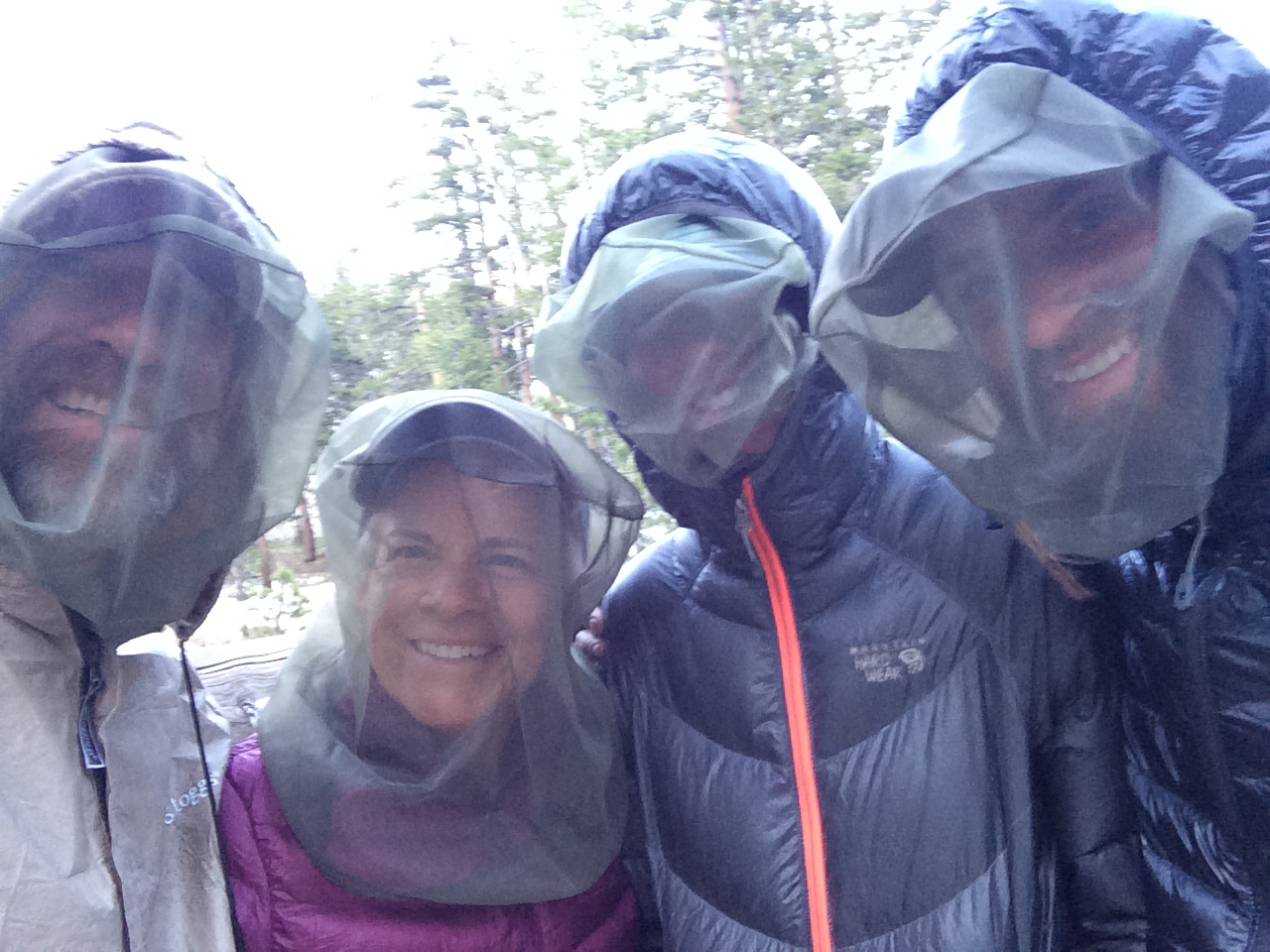
A Sierra trek, mosquito swarms, and the quieter truth that not all wilderness threats arrive as storms. Some work on the soul one small irritation at a time until relief from irritation feels more urgent than the wonder of the trek.
Part 1: Mosquitoes
In 2015, my wife and I entered the Sierra with Danny and Melanie through Onion Valley, climbing past the cold, clear lakes below Kearsarge Pass and up into that austere granite country where the world begins to feel stripped down to stone, sky, breath, and effort. The trail led us past water so still it seemed to hold the whole sky inside it, then upward through switchbacks toward Kearsarge Pass, where the air thinned and the land opened into that severe western country falling away toward Bullfrog Lake and the John Muir Trail. The Sierra has its own kind of honesty. It offers grandeur without comfort. It does not flatter. It does not care who you are, what titles you carry, the brand or how much your paid for your gear or how confident you felt at the trailhead. It simply asks whether you can keep walking truthfully through what it gives you.
And somewhere along that stretch, the mosquitoes became biblical.
They rose in clouds and followed us with relentless devotion. They hovered at our heads, pressed at our ears, and found the places where our shirts touched skin and drilled through. Every pause became a kind of small siege. The granite remained magnificent. The lakes were still beautiful. The sweep of the Sierra still carried that severe splendor that makes a person feel both small and strangely alive. But the mosquitoes worked on the mind with patient persistence. They narrowed attention. They thinned conversation. They shortened patience. They made relief feel more urgent than wonder.
That is one of the quieter truths of wilderness. It is not always the dramatic hardship that tests a person most deeply. Sometimes it is the steady abrasion of small miseries. Sometimes what works on the inner life is not the storm, but the swarm.
By the time we made our way down to Muir Trail Ranch, it felt less like arrival and more like a race for rescue. We did not care what the mosquito head nets cost. We were in no mood to compare prices or weigh thrift against suffering. We bought the nets, and we bought the bottle of DEET—harsh, toxic, and at that point entirely welcome. After enough days of being eaten alive, relief no longer feels optional. It feels like the only reasonable thing in the world.
That is one way the Attention Economy works.
It does not always strike as a crisis. More often it comes as a swarm of small intrusions—buzzing, needling, tugging, biting away at presence one irritation at a time. One alert. One notification. One headline. One vibration. One glance. One more check. None of them seems large enough to matter. Together they cloud judgment, fracture attention, and make relief feel more persuasive than purpose. Like mosquitoes, they do not have to stop the journey outright. They only have to keep biting until the mind begins to serve the irritation instead of the mission.
The Attention Economy is not a new wilderness condition.
That is important to understand if we want to see clearly.
It did not begin with social media, smartphones, push notifications, advertising platforms, machine learning or Artificial Intelligence. In one sense, it is as old as nature itself. Across the natural world, attention is constantly being summoned, redirected, and used. A bright flower catches the eye of the honeybee and lures it toward nectar, attaching pollen that will be carried to the next blossom. Brightly colored birds attract a mate. The anglerfish dangles its lure in darkness. Nature has long worked through signal, attraction, and response.
Attention itself is not the problem.
Attention is part of survival. It is how living creatures notice movement, danger, beauty, opportunity, food, and one another. The problem begins when attention is not merely invited but manipulated—when signal becomes bait, when attraction becomes capture, and when instinct is exploited in ways that do not nourish the one attending.
Human history has always had its own versions of this.
We must remember that it is always “modern times” to the living. Ancient people did not think of themselves as ancient. They were living in their present, with their own marketplaces, spectacles, scams, persuasive voices, false promises, and noisy claims upon the mind. Every age has had its clanging and banging attention getters diverting our attention to their lures and traps.
In the ancient marketplace, the Attention Economy was already at work. There was the loud, high-pitched rapid-fire voice, the scammer, the merchant with rigged scales, the seller of cure-all potions, the manipulator who played on fear, vanity, pain, and hope. A person in uncertainty wants answers. A person suffering wants relief. A person facing illness wants a miracle cure. A person in fear wants reassurance. The lure does not have to be true. It only has to arrive when the human soul is vulnerable enough to want it. That’s what the mosquitoes do. They distract us from what is important and make us vulnerable.
The same pattern has played out in religion in all its variations throughout history. This is worth naming carefully, because the struggle for attention has never belonged only to commerce. Spectacle, fear, belonging, exclusivity, ritual performance, emotional contagion, and the promise of certainty have all at times been used to seize the soul’s attention. The lure of eternal salvation—but only here. Belonging—but only with us. Safety—but only under this authority. Meaning—but only through this ritual. Again, the point is not to dismiss religion. The point is to recognize a human pattern: attention can be captured even in the name of what is holy is fear, longing, guilt, hope, and identity are manipulated strongly enough.
So the Attention Economy is not new in essence.
What is new is the technological evolution of its machinery.
In the ancient world, a person usually had to go to the marketplace to be caught up in the noise – to walk into the clamor of shouted claims, flashing wares, persuasive voices, rigged scales, cure-all promises, and all the rest. The mosquitoes waited in a place – the edge of the swamp. A person might choose to enter that place, linger there, or walk away from it. But the modern attention economy no longer waits in the marketplace. We carry it in our pockets. We strap it to our wrists. Some now even place it before their eyes in the form of glasses that keep the marketplace-mosquitoes humming at the edge of vision. The old marketplace occupied a location. The new one rides with us, sleeps beside us, interrupts our prayers, follows us onto the trail, and waits at the bedside before the first breath of morning – and if we can admit it joins us on the toilet! The mosquitoes are no longer merely visited. They are an omnipresent swarm.
The modern system studies what startles you, what flatters you, what comforts you, what enrages you, what keeps you watching – even for seconds – what makes you return, what turns your insecurity into habit-energy of checking, what turns your loneliness into dependency, what turns your outrage into engagement. It learns your cravings in real time and feeds them back to you in forms tailored to your own fears, appetites, desires, aversions, jealousy, despair, anger, vanity, and hunger for belonging. The mosquitoes are more sophisticated now, but they stir the same ancient human tendencies.
Companion Guide — Marcus Aurelius
When I think about the mosquito side of the Attention Economy, I find Marcus Aurelius to be a steady companion guide. He understood that a person can be pulled in two directions at once: scattered by distractions, or exhausted by restless activity that has lost its governing purpose. He wrote:
“Do the things which fall upon thee distract thee? Give thyself time to learn something new and good, and cease to be whirled around.”
That is Base Camp language. The mosquito side of the Attention Economy does not only distract us with small irritations. It also wears us down into aimless activity, restless checking, and the feeling of being busy without being truly present. Marcus reminds us that the answer is not simply to do less, but to stop being whirled around and to recover an inner-governing object—a steadier center from which thought and action can once again be directed.
Internal Practice — The Mosquitoes
Internal Focus: Small irritations can erode presence one bite at a time.
First: Enter Base Camp (2 minutes)
Entering Base Camp
Before beginning the practice, enter Base Camp.
This is not about solving anything yet. It is about returning to the inner place where choice becomes possible again. In the language of Buddhist practice, this movement follows a simple path: Stop, Calm, Rest, Heal.
Stop
Stop your forward motion for a moment.
Stop the momentum of thinking.
Stop the pull of habit energies.
Stop, as best you can, the physical and emotional tension you have been carrying.
You do not need to force silence.
You only need to stop feeding the movement.
Calm
Now enter Base Camp by calming the body and mind.
Begin at the top of your head. Focus on relaxing your forehead, and especially the muscles between the eyes. Then relax your jaw, shoulders, and arms, and feel the tension exit through your hands.
Now take five slow breaths.
Breathing in, silently say:
I am calm.
Breathing out, silently say:
I am restful.
Repeat this for five breaths.
Breath 1
Breathing in: I am calm.
Breathing out: I am restful.
Breath 2
Breathing in: I am calm.
Breathing out: I am restful.
Breath 3
Breathing in: I am calm.
Breathing out: I am restful.
Breath 4
Breathing in: I am calm.
Breathing out: I am restful.
Breath 5
Breathing in: I am calm.
Breathing out: I am restful.
Rest
Having stopped and calmed, allow yourself to rest in Base Camp for a moment.
Do not rush ahead.
Do not strain to accomplish anything.
Let the breath be natural.
Let the body soften.
Let the mind settle.
Heal
From this place, you are ready to look more deeply.
Not harshly.
Not hurriedly.
But gently, kindly and truthfully.
Insight is part of healing.
When you can see clearly what is happening within you, the work of healing can begin.
Now continue into the rest of the practice.
Step 1: Read or reflect with one question
What has been biting at my attention lately?
Not the dramatic storm.
Not the major crisis.
The small things.
The repeated things.
The nagging things.
The ones that do not seem important enough to matter—until they do.
Step 2: Reflection
What small irritation has been working on me repeatedly?
What happens in me after enough “little bites” accumulate—impatience, resentment, scattered attention, sharp tone of voice, facial expression or body language, self-pity, compulsion to escape?
Where in my daily life do I most often begin serving the irritation instead of focusing on the mission?
Step 3: One small action this week
When a small irritation arises, take three slow breaths – inhale through the nose, exhale through the mouth – before reacting.
Name the irritation quietly:
“This is a mosquito whose name is_______________________”
Choose one response you can respect afterward:
- soften your tone
- delay your reply
- return to the task in front of you
- step away for sixty seconds
- refuse one unnecessary check of phone, email, or alerts
If the irritation is digital, remove one bite source for a set period of time:
- silence one notification stream
- put the phone out of reach and out of sight during one activity
- begin the morning without checking messages
Step 4: Trail marker (one sentence)
“When the mosquitoes rise, I will return to Base Camp before irritation chooses my response for me.”
Next Essay
The mosquitoes matter because small irritations are never merely small for long. Left unattended, they thin the inner life, shorten patience, and train us to serve the discomfort rather than our purpose. But if we learn to notice the bite and return to Base Camp, we begin to recover something precious: the ability to remain present without being ruled by irritation. In Part 2, we’ll go farther—from the swarm to the lure, from distraction to capture.led by irritation. In Part 2, we’ll go farther—from the swarm to the lure, from distraction to capture.