
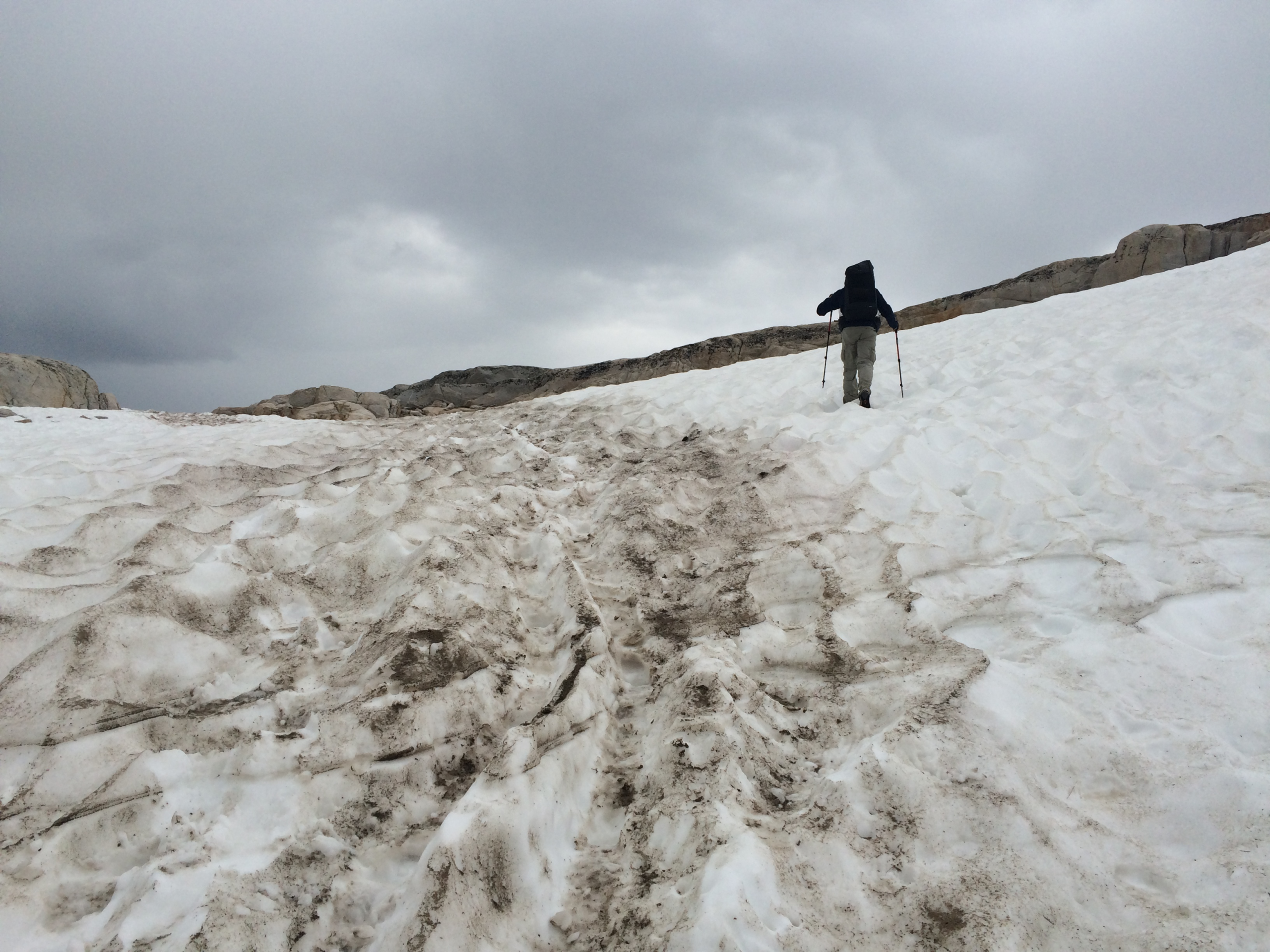
When the terrain is unchosen, base camp becomes the only place freedom can be protected
Some wilderness has a trailhead. We choose it. We plan for it. We tell stories about it later.
But much of life is not chosen in that way.
We did not choose our first family.
We did not choose our DNA or the resulting hairline… or lack thereof.
We did not choose our childhood home, our earliest wounds, our first language, or the culture that shaped our instincts before we were old enough to name them.
And sometimes we don’t choose the wilderness we enter either. A diagnosis. A job loss. Betrayal. Trauma. War. An accident. A situation that arrives like a door slamming shut behind you. You’re in it, and you didn’t sign up. This post is about that kind of wilderness.
Because if our philosophy only works when wilderness is scenic and chosen, then it isn’t philosophy. It’s comfort. The question is not whether we will encounter unchosen wilderness. The question is whether the base camp within us is real—strong enough to enter when the terrain is not.
A wilderness we didn’t choose: March 16, 2020
On March 16th, 2020, the pandemic shut down the school I founded eight years earlier and continued to lead. Overnight, the world changed and Overnight, the world changed and campuses across the country along with ours went quiet. We were forced into remote learning. None of us knew how to do that—at least not at the scale and speed we were facing.
As executive director, it fell to me to make difficult decisions with incomplete and often contradictory information. We had to find money to purchase nearly 1,000 student computers. Had to figure out how to distribute them during a pandemic and to help teachers, families, student learn new practices in real time. To communicate with families who were anxious, angry, exhausted, or simply afraid. To keep a sense of hope and direction when the wilderness felt dark and—some days—hopeless. For eighteen months we remained remote. The choice to return to in-person learning was removed from me. The terrain was outside my control. But not everything was removed.
The choice to learn how to do remote teaching remained.
The choice to serve our community remained.
The choice to respond with steadiness rather than panic remained.
One day I learned of a family who was out of simple food—and out of the coveted rolls of toilet paper that, for a season, felt like currency. I went to the elementary campus, grabbed a large trash bag, and filled it with rolls of toilet paper. Then I drove to the food bank and loaded a box of basic groceries. I put it all in my truck and delivered it to that family.
It wasn’t a heroic act. It was a human one. But that’s the point.
In an unchosen wilderness, I could have complained, wrung my hands in worry, or lived in constant resentment toward what I could not control. Or I could do one small thing to relieve the mental, spiritual, and physical suffering of the community we served.
That was a choice still available.
And that is where wilderness becomes a moral teacher: it removes many options, but it does not remove all of them.
The hard-miles of the pandemic taught me something I can’t unlearn: when the wilderness is unchosen, the work becomes interior. You don’t get to choose the terrain, but you do get to choose how you will live inside it. Admiral James Stockdale learned that lesson in a far harsher wilderness—one where Stoicism wasn’t a philosophy, but survival.
Stockdale: “Entering the world of Epictetus”
Admiral James Stockdale didn’t choose his wilderness either.
In September 1965, his plane was shot down over North Vietnam. As he ejected, he understood—instantly—that the next season of his life would not be a “hard week” or a “difficult assignment.” It would be captivity. He later wrote that he had “about thirty seconds” before landing to speak his last line of freedom to himself, and he whispered: “I’m leaving the world of technology and entering the world of Epictetus.”
That sentence is more than dramatic. It’s a map.
Stockdale had been trained in Stoicism years earlier and carried Epictetus as a living guide. In that moment, he knew what the wilderness would try to do: strip away control, identity, dignity, and hope. So he returned to the most basic Stoic move—what Epictetus calls the division between what is within our power and what is not. Stockdale described it as keeping two files in the mind: things that are “up to him” and things that are “not.”
That is base camp language.
He could not choose the circumstances. But he could choose where to place his attention, what judgments to assent to, what principles to hold, and what kind of man he would be inside the prison. Stockdale’s unchosen wilderness became a laboratory where Stoicism moved from philosophy to survival—and where leadership became moral stewardship under pressure.
And that’s why his story belongs here: it shows that base camp is not comfort. Base camp is inner governance when the outer world is closed.
Stockdale framed the problem in Stoic terms: what is up to me, and what is not. Viktor Frankl framed it in existential terms, but he arrived at the same truth: even when circumstances are brutal beyond imagination, the inner life still contains a narrow space of freedom.
Frankl’s wilderness: thrust into the camp
Viktor Frankl did not choose his wilderness. He was a physician, a thinker, a man with a life and a future. And then he along with his pregnant wife was deported into Nazi concentration camps. That is the kind of wilderness modern people struggle to imagine. It wasn’t “hard miles.” It was dehumanization, starvation, brutality, and the daily uncertainty of survival. It was a world designed to crush the inner life. And yet, in that extreme wilderness, Frankl discovered something that sits at the core of everything we’ve been writing:
Even when the outer world is taken, something interior can remain. He called it “the last of the human freedoms”—the ability to choose one’s attitude, one’s inner response, even when circumstances are unbearable. “Everything” he wrote “can be taken away from a man but one thing: the last of the human freedoms – to choose one’s attitude in any given set of circumstances, to choose one’s own way. And there were always choices to make.” That claim isn’t sentimental. It’s reality. It’s born in a place where cheap optimism dies quickly.
Frankl’s point wasn’t that a person can control the wilderness. His point was that a person can still protect the soul from becoming nothing but wilderness.
He noticed that some people, even in camps, retained dignity—mentally and spiritually—because they maintained an inner hold on what mattered. Others did not. The difference wasn’t merely circumstances. It was the interior decision—again and again—about what kind of person they would be.
This is where modern life gets exposed. We speak as if our inner life is completely determined by our surroundings—by stress, culture, upbringing, personality, trauma, fatigue, hormones, the economy, the news cycle.
And many of those influences are real.
But if we accept the idea that we are only products of our environment, we become something worse than tired.
We become helpless.
Frankl forces a sharper question:
Is a human being “completely and unavoidably influenced” by surroundings… or is there still a narrow space where choice lives?
Corrie ten Boom: the wilderness she chose—and the one she didn’t
Corrie ten Boom’s story adds another layer. In one sense, she did choose wilderness.
She and her family chose to help hide Jewish people in the Netherlands during the Nazi occupation. That choice was not an accident. It was a moral line in the sand. But after that choice, there was a wilderness she did not choose: arrest, imprisonment, and Ravensbrück.
That is an important distinction.
Sometimes we choose a faithful path… and the wilderness comes anyway.
Corrie tells a story from the camp that sounds almost absurd until you realize how deep it is. Her sister urged her to give thanks even for the fleas in their barracks. Corrie resisted—until she learned the fleas kept the guards away, giving them space to survive and to serve other women. The point isn’t that fleas are good. The point is that when you are thrust into wilderness, you begin to learn a different kind of sight: the ability to find meaning, mercy, or even a small advantage that keeps your soul from collapsing.
It’s base camp vision.
Not denial.
Not positivity.
Not “making the best of it.”
A kind of inner steadiness that refuses to be reduced to the prison.
Wilderness without and within
Stockdale, Frankl and Corrie all testify to the same reality:
Wilderness is not only external.
The wilderness without is the circumstance.
The wilderness within is what the circumstance tries to turn you into.
That’s why this matters for ordinary people.
Most of us will not face POW or concentration camps and hopefully we won’t face another world-wide pandemic. But many of us will face a kind of captivity:
- chronic stress
- illness
- grief
- family dysfunction
- addiction—ours or someone else’s
- financial collapse
- a broken relationship we didn’t choose
- a child’s suffering that we cannot fix
- hard miles where we are stripped of control and left with only response
In those hard miles, the question becomes simple:
What remains of freedom when the wilderness is not chosen?
Frankl’s answer is demanding:
Freedom is not primarily the ability to change circumstances.
Freedom is the ability to choose who you become within them.
And this is where base camp becomes more than metaphor.
Base camp is the space where freedom lives
We’ve been building toward this in quiet ways.
Between stimulus and response there is a space.
Wilderness is the stimulus.
Base camp is the space.
The response is the choice.
When the wilderness is unchosen, base camp becomes essential.
Because you may not be able to leave the outer terrain. But you can still return inward—again and again—to reorient to true north principles:
- tell the truth
- stay steady
- refuse bitterness
- do the next right thing
- do not trade integrity for relief
- love where love is still possible
This is not self-help. It’s moral formation. It is the work of refusing to become an animal inside the pen. And it is the work of staying human.
In the hard miles of the pandemic, I couldn’t change the terrain—but I could return to base camp, remember what mattered, and choose one next act of service. That’s what this practice is for: not to erase hardship, but to protect the space where response is still possible.
Learn this – Wilderness is the stimulus. Base camp is the space. The next right step is the response. This practice helps you locate that space again—especially when the wilderness wasn’t your choice.
Internal Practice — Unchosen Wilderness, Chosen Response (5 minutes)
This practice is not about pretending your suffering is small.
It is about protecting the space where choice still lives.
1) Name the unchosen wilderness (1 minute)
Write one sentence:
“The wilderness I did not choose is…”
Be specific. Plain. No emotion, No drama.
2) Name what it’s doing inside you (1 minute)
Write:
“Under this pressure, I notice myself becoming…”
(irritable, numb, controlling, despairing, bitter, anxious, avoidant)
This is wilderness within.
3) Return to base camp (1 minute)
Three slow breaths.
On the in-breath silently say: “I return.”
On the out-breath silently say: “I can choose.”
4) Choose one brief and fundamental principle (1 minute)
Write one true north principle you will not abandon during these hard miles:
“Even here, I will…”
(tell the truth / be kind / stay steady / refuse resentment / do the next right thing)
5) Take one small next step (1 minute)
Before you choose your next step, sort the moment into two files: what is up to me – in my control, and what is not in my control.
Write:
“The next right step that is up to me – (within my control)…is…”
Small. Quiet. Real.
And when the wilderness returns tomorrow—as it will—return to base camp again.
Trail sign toward the next post
Some wilderness is chosen. Some wilderness is unchosen.
Either way, the central question remains:
What does this wilderness reveal—and what will I do with what it reveals?
Unchosen wilderness clarifies something essential: I may not control the terrain, but I can still protect the space where choice lives.
But that raises a practical question.
If Base Camp is the inner refuge—quiet enough for freedom—what happens when the “trail conditions” of life begin to wear it down?
Because in both wilderness and life, it’s not only the dramatic storms that exhaust you. Sometimes it’s the small, relentless conditions: the buzzing mosquitoes of distraction, the shifting weather of instability, the quiet hunger for approval that never quite satisfies. They don’t always break us in a single moment. They erode us mile by mile.
Modern Wilderness Conditions
In the next post, we will begin the transition from wilderness as a teacher to Base Camp as a responsibility. We’ll start naming the conditions that threaten the inner life, and we’ll begin learning—primarily through the Buddha via my guide Thich Nhat Hanh—how to stop habit energy, return to breath, and come home to ourselves.
And I’ll tell a simple story from my own land: clearing fence lines choked by blackberry brambles—what neglect creates, what steady attention restores, and why inner life requires the same kind of patient tending.
Thank you for reading Greybeard Philosophy. If this essay helped you, stay with the practice—small and faithful is enough. Until next time: be kind to yourself and learn something for the next trek.
If it is helpful to you, please share with someone you care about.
Until next time: by kind to yourself and learn something for the next trek.