
What Lack I Yet? The Hedonic Treadmill Hunger for More
Tagline: The problem is not what I lack. The problem is what still has me.
Listen to the podcast on your favorite platform.
Welcome to Greybeard Philosophy, bringing ancient wisdom and daily practice to the inner life and the wildernesses we journey, one practice at a time. I’m Brian Winsor.
In the last reflection, we explored the first hunger of the soul: the hunger for applause. That hunger asks, “Who saw me?”
In this reflection, we turn toward the second hunger: the hunger for more. This hunger asks another question: “What lack I yet?”
It’s the question the rich young man brought to Jesus. It’s also a question that still walks through modern life. It walks through careers, families, churches, schools, bank accounts, social media feeds, homes, garages, gardens, calendars, and even good works.
“What lack I yet?”
It can be a holy question when it is asked from the right place.
What remains unfinished in me?
What attachment still governs me?
What part of Base Camp is not free?
What is the next faithful step toward wholeness?
Asked that way, the question can lead toward formation. But the same question leads to an insatiable hunger for more if viewed through the eyes of scarcity and comparison.
What lack I yet so I can keep up?
What lack I yet so I can stay ahead?
What lack I yet so I can feel successful, secure, admired, or complete?
That is the Hedonic Treadmill. It’s the hunger for more that follows every meal.
It begins with the quiet belief that peace is located just beyond the next acquisition. One more achievement. One more title. One more purchase. One more improvement. One more completed project. One more financial cushion. One more proof that the life I am living is worthy.
But “more” is a strange food. It gives energy for a while. Then it leaves the soul hungry again.
Tyler and the Clover
Most mornings now, I walk a quiet country road in Northern Alabama. Carleigh, my faithful dog, usually accompanies me. The road bends between oak and maple trees, blackberry vines, pasture fences, and thick summer vegetation. Cows with their calves graze in the fields. Birds sing from the tree line. Squirrels chatter and scold from the branches.
It’s a simple walk. Or at least it should be. If I’m not careful, my mind slips back into the old current of productivity. What needs to be done today? What should be measured, improved, organized, built, planted, cleared, written, or repaired? The body is walking a country road, but the mind is already back inside a management system.
One morning my youngest granddaughter Tyler came with me. I love our walks together. There isn’t sufficient language to describe the love I feel for her and my other grandchildren.
Tyler is nearly two with all the characteristics of that phase. She has very little sense of ownership. Much of what she sees, she assumes belongs to her. What she wants, she wants when she wants it. Like most toddlers, she can be impatient, stubborn, loud, delighted, and utterly convinced that whatever her brother or sister is holding must be better than what is already in her own hand.
So, this isn’t a sentimental argument that children are pure and adults are ruined. But there are moments – especially outside – when her inner life seems wonderfully uncluttered.
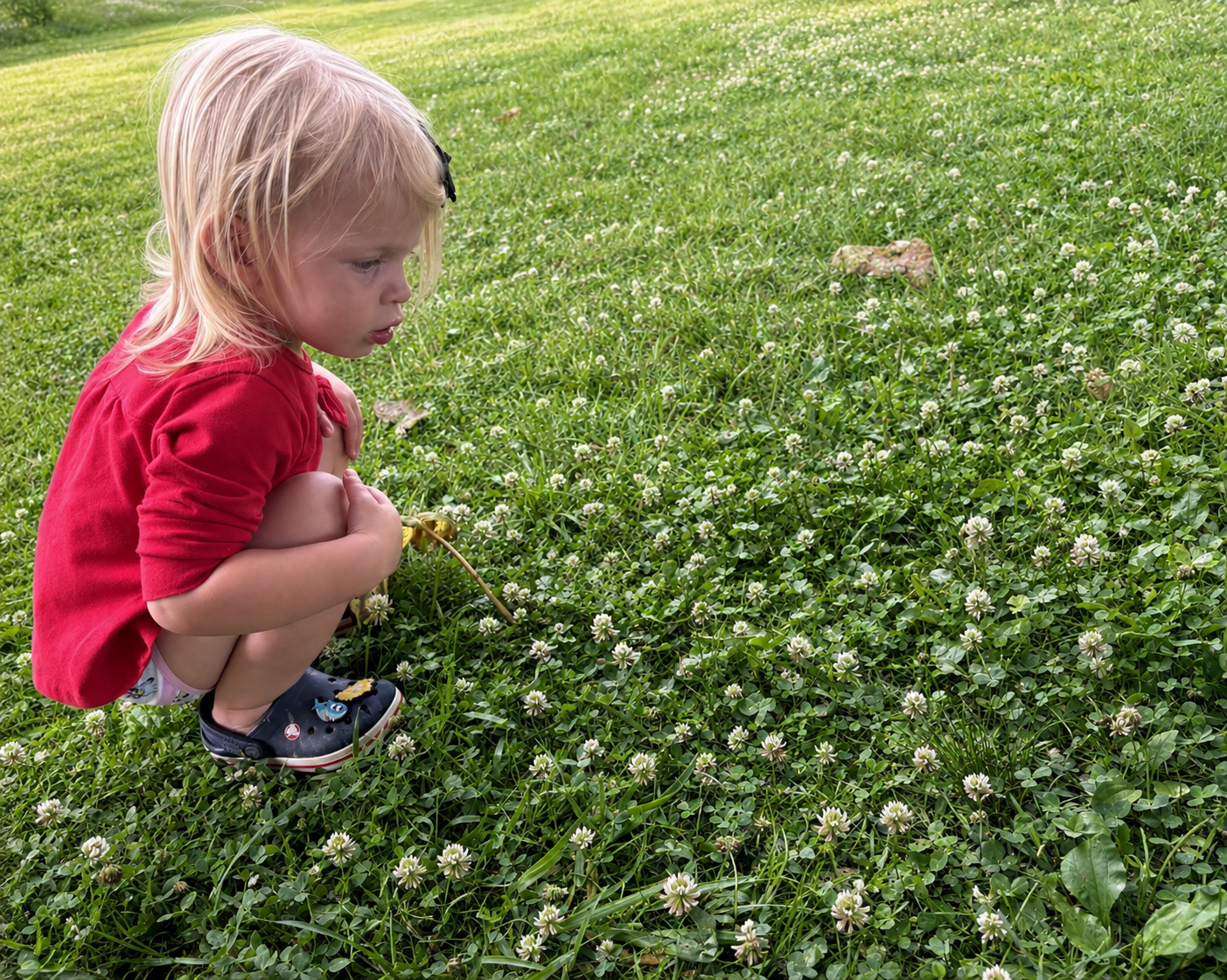
On that walk, her small hand wrapped around my finger. We moved along the grass, past clover and garden beds. Suddenly she stopped with a gasp and pulled me downward. She pointed to a clover blossom where a large bumblebee was gathering nectar from each little floweret.
So there we crouched. We watched the bee work. Finally, it lifted and flew away. We stood and took a few more steps. Then she stopped again and pulled me down with her.
Another clover.
Another bee.
Another gasp.
Another whole world.
Later, near the blueberry bushes, she grazed with delight. She carefully selected the dark blue berries and left the green ones. With each berry, she seemed newly amazed, as though the world had once again produced a miracle right at mouth level.

That is presence.
Not purity.
Not perfection.
Presence.
Tyler has not yet learned to turn every moment into evidence. She hasn’t learned to compare gardens, measure productivity, compete for status, calculate legacy, or ask whether the blueberry harvest proves anything about her worth.
She can receive a berry as a berry. A bee as a bee. A bird as a bird.
Adults have a harder time. Somewhere along the way, many of us learn to turn life into proof. The walk becomes exercise data. The garden becomes output. The house becomes status. The child becomes a report card. The career becomes identity. The bank account becomes security. The calendar becomes importance. The good deed becomes evidence that we are useful.
That doesn’t mean building, producing, improving, organizing, accumulating, or optimizing are wrong. They are not.
The issue again, is motive.
Why am I building?
Why am I improving?
Why am I planting?
Why am I teaching?
Why am I accumulating this?
If the act is rooted in goodness, beauty, nourishment, responsibility, and love, it can be part of formation. But if it is rooted in comparison, display, insecurity, or the hunger to accumulate enough proof that I am finally enough, then the act begins to sour.
The garden may still grow. The house may still rise. The chickens may still be fed and eggs gathered. The writing may still reach people. But something in Base Camp has been pulled onto the treadmill.
How We Learn to Run
Most of us are handed treadmills before we know their names.
Some are handed to us by family expectations. Some by school rankings. Some by religious systems. Some by career ladders. Some by athletics, beauty, income, productivity, social media, or the quiet comparisons that live inside neighborhoods and extended families.
Run faster.
Earn more.
Achieve more.
Prove more.
Become more impressive.
Gather more evidence that you matter.
My version came through a mixture of good things: faith, family, service, education, leadership, military achievement, and the desire to be useful. None of those things were bad. Many formed me. Many were rooted in sincere sacrifice and duty.
But somewhere along the way, I began to confuse visible signs of worth with worth itself. And worse, I tried to pull my children onto the same treadmill.
My sons resisted it. At the time, I experienced their resistance as danger, rebellion, and loss. I wanted them to follow the validation pathway I had inherited. I believed I was guiding them. Looking back, I can see that I was pressing them toward a treadmill that had already weakened me, while believing I was saving them. I lost their trust and presence for a season. The memory still instructs me.
The treadmill doesn’t only exhaust the person running on it. It can recruit that person into becoming an unknowing agent of the treadmill for others.
Parents can place children on it.
Schools can place students on it.
Churches can place believers on it.
Organizations can place leaders on it.
Cultures can place whole generations on it.
This is why the question matters.
“What lack I yet?”
When asked from scarcity, that question does not free a person. It enslaves him to the next mile marker.
The Question That Reveals Attachment
A rich young man came to Jesus and asked, “Master, what good thing shall I do, that I may have eternal life?”
Jesus answered him simply: keep the commandments. The young man responded that he had kept them from his youth. Then came the piercing question from the heart of the young man:
“What lack I yet?”
It is hard not to admire the question. He wasn’t careless. He wasn’t morally indifferent. He wanted to know what remained. But Jesus didn’t tell him to add another credential, another religious performance, another possession, another public achievement, or another symbol of worth. He placed his finger on the attachment.
Go.
Sell.
Give.
Come.
Follow.
The young man went away sorrowful because he had great possessions.
That sorrow tells the truth. He didn’t simply have possessions. His possessions had some claim on him. They had become part of the architecture of his identity, safety, status, and imagined completeness.
He couldn’t pass through the narrow gate while carrying the identity his possessions had given him.
That’s where the hunger for more becomes a wilderness condition. It convinces the soul that lack is always external.
If I only had more of this, then I would be whole.
If I only gained that, then I would be secure.
If I only finished this project, then I could rest.
But Jesus did not answer, “Add one more thing.” He answered, “Release what has you.”
The Buddha would recognize the same problem. The language would be different, but the diagnosis would be close: craving, attachment, grasping, the mind that keeps manufacturing lack even when the outer life is full.
Non-attachment isn’t neglect. It is freedom. It isn’t walking away from love. It is walking away from bondage.
Can I lead without needing leadership to validate my importance?
Can I tend the garden without needing the garden to define me?
Can I care for the chickens without needing my systems to prove my competence?
Can I write without needing the writing to secure my importance?
Can I teach grandchildren without needing the role to validate my legacy?
That is the harder work.
Good Things for the Wrong Reason
A quiet life is not automatically a free life. The treadmill can follow a person anywhere. It can move from the boardroom to the henhouse. From the conference room table to the kitchen table. From the pulpit to the living room. From performance reviews to parenting. From social media metrics to church service. From school grades to retirement portfolios.
The scenery changes. The inner hunger may not.
When I imagined a quieter life, I think I imagined simplicity would come with the zip code. A rural road, family nearby, gardens, chickens, trees, pasture, grandchildren running across the land. But a person can bring an unquiet soul into a quiet place and immediately begin trying to improve everything in sight.
I can feel it in the garden. I plant for nourishment. I plant for beauty. I plant for legacy, hoping my grandchildren will know the feel of soil in their hands and remember the taste of blueberries, snap peas, tomatoes, and whatever else the earth gives us. I plant because I love learning how things grow. Those are good reasons. But even in the garden, motive can sour. It happens when the language changes:
Look what I planted.
Look at my garden.
Look how my plants are growing.
Look what I produced.
When I, my, me, and mine begin taking over the sentence, I can smell the motive turning.
Sometimes the hunger for more isn’t greed. Sometimes it’s fear that enough will not be enough. The garden teaches that slowly.
So does the hen house.
Responsibility Without Applause
A neighbor graciously permitted me to take over care of his chickens: twenty-seven hens and four roosters. There is something grounding about entering the hen house in the morning, hearing the clucks, gathering eggs, checking water, and noticing the flock. One fluffy hen is often still in her box when I arrive. Her wings and breast feathers fill the nest. She chortles and pleads as though asking me to leave some eggs to hatch.
“Good morning, momma hen,” I say. “How many eggs this morning? I know you want to keep them, but this isn’t a place to become a momma. Thank you for laying these eggs. We will enjoy them.”
Then I carefully reach under her and gather the eggs while she complains.

There is a simple holiness in that kind of daily work. But even there, the seeds rise. I improved the watering system. I improved the feeding system. That work was for care, reliability, stewardship, and efficiency. But if I am honest, I also enjoy improving systems. I see something wobbly and want to make it smooth. I see inefficiency and want to correct it.
That ability has served me well in leadership, schools, business, and life. But the seed of pride can sprout there too.
Does no one see this amazing watering system?
Does no one notice how many eggs I brought the family?
Does no one appreciate how much better this works now?
When those weed-seed thoughts rise, I try to see them, smile at them, and say: “I am not watering you today.”
The chickens don’t need me to be impressive. They need clean water. They need food.
They need presence. They need me to understand that they don’t exist to validate my hunger for more achievement.
I learned that one morning when the large white rooster attacked me from behind. Pain shot into the back of my calf. Something was jack hammering my knee. I looked down and saw him striking. I limped back to the house bleeding and in pain. For a moment, I considered rooster and dumplings for dinner, though I suspected he would be too tough even for that.
Then the Stoic question came:
What is in my control? Not the rooster’s instincts.
What is in my influence? My preparation, my posture, and my response.
The next day I returned with a small squirt bottle filled with water. The rooster attacked. I stood my ground, sprayed him in the face, and firmly said: “Back. Back. Back.”
He backed away, shaking his head in confusion. Rooster Cogburn and I now have an understanding. If he comes near me with murder in his heart, he gets sprayed in the face.
This too is Base Camp training.
I do not own that space. It isn’t a validation station to prove my worth. I have influence within it, responsibility within it, and limits within it.
The chickens are a daily school in simple responsibility without needing more.
That is stewardship. Not accumulation. The difference matters.
What Has Me?
So, I return to the rich young man. What would Jesus place his finger on in me?
The issue is not whether education, service, military experience, business leadership, family, home, land, gardens, chickens, and writing are good. Many of them are deeply good. The question is whether they are free from the treadmill. Do I hold them in stewardship, or do they hold me in identity?
This is where enough begins.
Enough is not laziness.
Enough is not lack of ambition.
Enough is not quitting the work of stewardship.
Enough is the condition of a soul that can receive without grasping and build without bondage.
Enough asks a different question: What is already rich here?
The answer is everywhere.
A toddler gasping at a bee in clover.
Blueberries darkening on the bush.
Grandchildren with dirt on their hands.
A hen chortling over eggs.
A rooster who teaches boundaries better than a leadership seminar.
A writing desk where thoughts become clearer.
A country road where Carleigh reminds me that presence is not performance.
What lack I yet? Perhaps less than I think.
Perhaps the question isn’t: What do I still need before I can be at peace?
Perhaps the real question is: What do I need to release before I can be at peace?
The problem isn’t what I lack. The problem is what still has me.
The hunger for applause says, “Who saw me?”
The hunger for more says, “What lack I yet?”
Base Camp answers:
Return.
Look carefully.
Name the attachment without shame.
Water the seeds of abundance, contentment, love, stewardship, and freedom.
Let the weed seeds go dry.
Build what is good.
Plant what nourishes.
Feed what depends on you.
Teach who is before you.
Write what may help someone beyond you.
But do not ask any of it to make you finally enough.
Back to the Clover
And perhaps that’s why Tyler’s little hand around my finger stays with me.

She didn’t stop at the clover because it added anything to her status. She didn’t crouch beside the bumblebee because it proved her worth. She didn’t reach for the blueberry because it completed an identity.
She simply received what was there.
A clover.
A bee.
A berry.
A morning walk with grandpa.
Nothing needed to be upgraded before wonder could enter. Nothing needed to be possessed before joy could rise. Nothing needed to be compared before the moment became enough.
Maybe that is one way Base Camp begins to nourish the true hunger of the soul – not the hunger for more. Not by abandoning the garden, the chickens, the work, the writing, or the children we teach, but by learning again how to kneel beside one small clover without needing it to become evidence of anything. That’s the true soul’s hunger, to kneel beside a clover in fresh wonder.
What lack I yet? Perhaps, in that moment, less than I think.
Internal Practice — What Lack I Yet?
Before entering base camp we practice Shamatha – Stop, Calm, Rest, Heal.
Sit down or stand still. Put the phone away and out of sight.
Open your hands and quietly say:
“I am enough.”
“I do not need more before I can return.”
Take five slow deep breaths:
Breathing in I am calm, breathing out I am enough.
……………… I am calm, …………………. I am enough.
……………… I am calm, …………………. I am enough.
……………… I am calm, …………………. I am enough.
……………… I am calm, …………………. I am enough.
Next let your breathing return to a normal rhythm.
Notice any hunger for more: more recognition, more comfort, more security, more control, more possessions, more influence, more proof.
Don’t add shame to it. Simply name it:
“This is the hunger for more _________” and give it a name.
Then ask:
What do I still believe I lack before I can be at peace?
Is this a holy question or a comparison question?
Reflect on your current and ask: what is already rich here?
Final Prayer of Pure Intention
Let me walk for the deed, not the applause.
Let me receive the trail’s honesty without complaint.
Let me notice hunger without obeying it.
Let me see what I cling to, without shame.
Let me ask internally, “What lack I yet?” and listen with a humble heart.
Let me see the riches of my life through the eyes of abundance and Let me bring that abundance into Base Camp
If this reflection helped you name something in your own life, consider sharing it with someone who may be walking through a similar wilderness. Not as advice. Not as correction. Simply as a trail marker. Small reflections shared at the right time can become guides for someone else’s next step.
You can share the post, send it to a friend, or pass it along with one question:
“What do I need to release before I can be at peace?”
Until next time—be patient and kind with yourself, return to Base Camp, and learn something for the next trek.